Ten billion scans a day, and the barcode is changing
The barcode is becoming a QR code, and what it opens next is a decision for brands, not just a job for the artwork team.
The barcode is becoming a QR code, and what it opens next is a decision for brands, not just a job for the artwork team.
For fifty years the barcode has told the till what a product is and nothing more. The code replacing it will be a portal into your product telling the customer almost anything you want it to.
On 26 June 1974, a cashier called Sharon Buchanan at a Marsh supermarket in Troy, Ohio, passed a ten-pack of Wrigley’s Juicy Fruit over a scanner, and the till rang up 67 cents. It was the first product ever sold by reading its barcode. Five years later the same thing happened in Britain, at a Keymarkets store in Spalding, with a box of Melrose tea bags.
Those black lines are now scanned more than ten billion times a day, according to GS1, the not-for-profit that runs the system. It’s hard to think of another piece of design that does so much work and gets so little attention.
I’ve been deep in the world of barcodes lately, and it took me straight back to being 22, wandering around Asda House on a Friday afternoon to get ice lolly packaging signed off. Sweaty palm stuff. I could barely hold the cromalin, for fear of something being wrong and the wrath I’d incur if it was. Part of the sign-off was the barcode: was it the right one, and could a till actually read it?
Twenty-two years later I’m talking to GS1 UK, the people behind the barcode. A full-circle moment. I might even get a tattoo, and there’s an obvious candidate.
The reason I’m back there is that the barcode is changing more than at any point in its fifty years. GS1 wants tills around the world to be able to read two-dimensional codes, the QR code most of us know and the denser DataMatrix, by the end of 2027. It isn’t a law, and nothing gets switched off. GS1 UK is clear that the familiar barcode won’t disappear in 2027, and for a while plenty of packs will carry both. But the direction is set, and retailers are already moving.
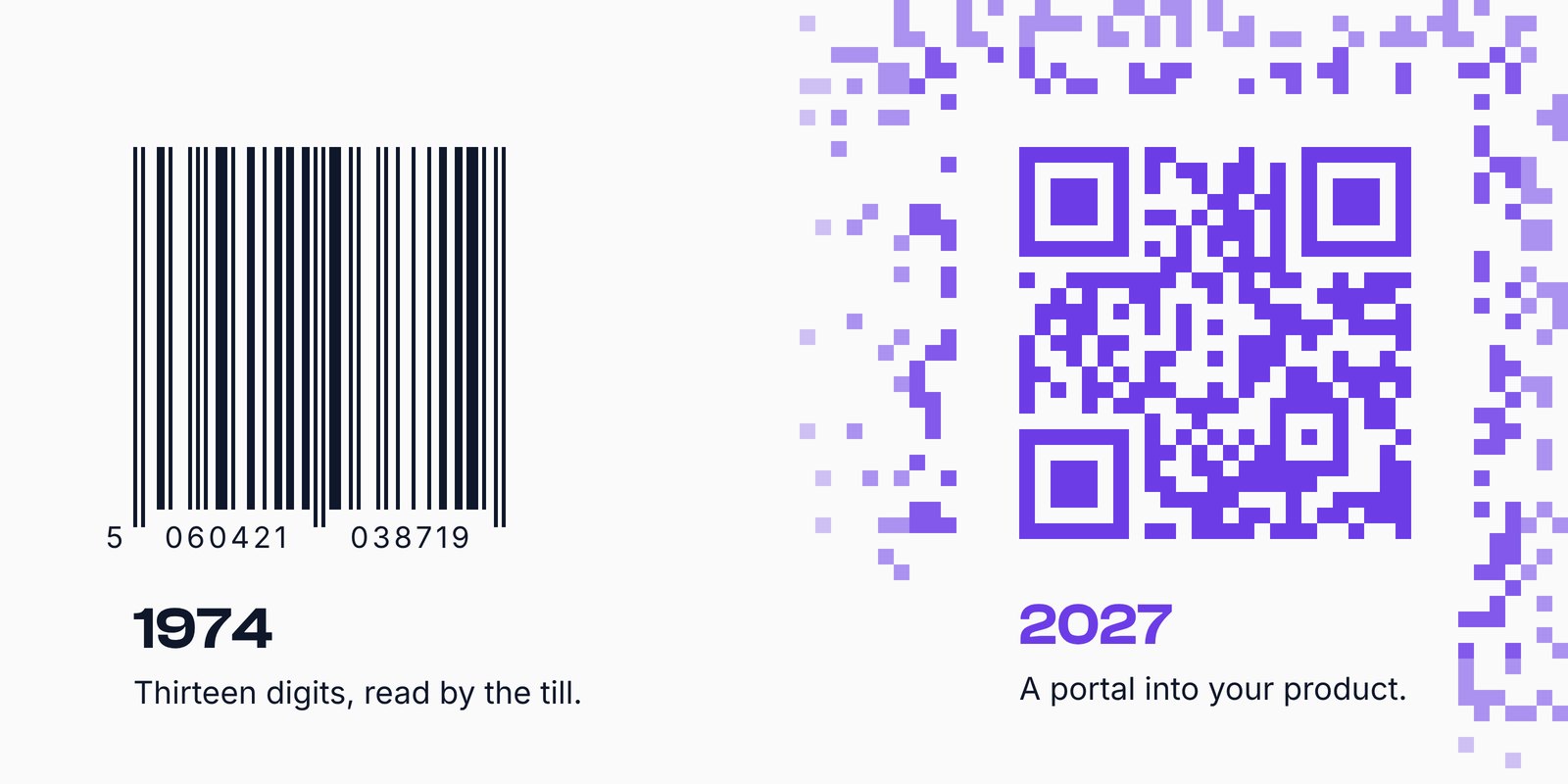
Tesco began trialling the new codes in 2025 on twelve of its own-brand meat and produce lines, in a small number of stores in southern England, working with GS1 UK and ten of its suppliers. The trial was about dates. A traditional barcode tells the till what a product is. It has no way of saying which batch it came from or when it goes out of date, so that information sits on the pack in print, for a person to read and occasionally miss. Put it in the code and the till can read it too.
Less waste is the benefit retailers tend to lead with, and fair enough. What interests me more is that the new code has two readers. The till reads a product number, a batch and a date. A phone reads the same code as a web address, and the camera takes you somewhere the brand chooses: ingredients, instructions, how to recycle it, a recall notice if there is one. For half a century the barcode only ever spoke to machines at the checkout and in the warehouse, and now it can speak to the person holding the product.
That second reader is where regulation is heading as the EU introduces Digital Product Passports, a digital record for each product covering things like what it’s made of, where it was made and how to repair or recycle it. Batteries go first. From 18 February 2027, EV, industrial and e-bike batteries sold in the EU need one, reached through a QR code on the battery, and textiles and other categories are expected to follow over the next few years. The code on the pack is turning into the front door for information that until now has lived in a spreadsheet, a PDF, or nowhere at all.
For most brands the barcode has always been an artwork job. You get the number from GS1, drop it into the pack design, check it scans and move on, and that part barely changes. But a QR code takes people somewhere, and someone has to decide where. Who owns that web address, and will it still work in five years? Who keeps the page accurate when a supplier changes or a batch is recalled? These are decisions about data and customer experience, and in most businesses they fall somewhere between the packaging team, the digital team and whoever looks after product information, which often means nobody quite owns them.
Packaging is planned a long way ahead, and the end of 2027 falls inside the next redesign for a lot of products. If one is coming up, it’s worth spending time on what the code should open, what experience it can provide to your customers and what regulatory needs it may cover. It’s a small decision at that stage, and a slow, expensive one to retrofit across a range once the packs are printed.
It’s also a real opportunity. This is one of those rare cases where compliance can fuel creativity. The rules are nudging brands to put a code on the pack that opens something, and what it opens is up to them. Done well, it gives a brand an open, ongoing dialogue with the people who buy its products, long after the till has done its job. I’d have loved that problem at 22, sweaty palms and all.
Insight
Swap launched the first dedicated agentic storefront recently, an early outlier that raises many strategic questions for brands and how they are accessed online.
Insight
Repair, lifespan, and what happens after the sale shape sustainability more than the report does.
Insight
DPP regulation reaches automotive sooner than expected. Batteries from February 2027, then tyres and vehicles. What to prepare for, where the opportunity sits.
We bring senior digital leadership across technology, product and sustainability.